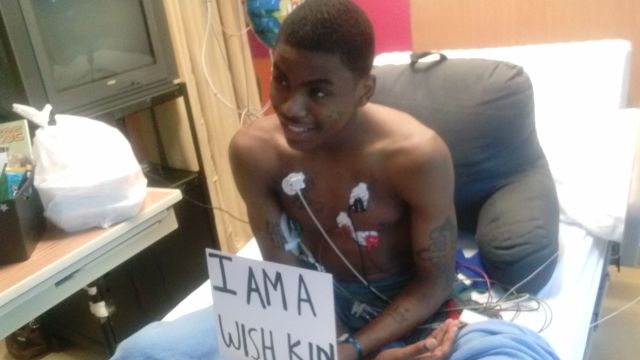
Anthony Stokes, 15, in the hospital where he was denied a heart transplant. (Source: CBS Atlanta)
Important updates below
Doctors at Children’s Healthcare of Atlanta estimate that without a heart transplant, 15-year-old Anthony Stokes will die within three to six months from heart failure. Yet despite his prognosis, they refuse to put Anthony on the transplant list, telling his family he doesn’t qualify due to “a history of non-compliance” characterized by “low grades and trouble with the law.”
“They said they don’t have any evidence that he would take his medicine or that he would go to his follow-ups,” Melencia Hamilton, Anthony’s mother, told WSBTV. Hamilton says that a transplant is the only option for her son’s enlarged heart.
In a recently issued statement, the hospital would not reveal any specifics about how they came to their decision, saying, “The well-being of our patients is always our first priority. We are continuing to work with this family and looking at all options regarding this patient’s health care. We follow very specific criteria in determining eligibility for a transplant of any kind.” The hospital wants to send him home with medication, presumably to die.
But Anthony’s loved ones haven’t given up on him. Neither has the Southern Christian Leadership Conference (SCLC), which has taken up his cause.
“He’s been given a death sentence because of a broad and vague excuse of noncompliance. There was nothing specific in that decision. Just noncompliance,” Christine Young Brown of the SCLC told CBS Atlanta.
Mack Major, Anthony’s mentor, added, “We must save Anthony’s life. We don’t have a lot of time to do it, but it’s something that must be done.”
It’s no secret that children of color, particularly black children, are far more likely to be suspended and expelled for minor infractions than their white peers, pushing them out of the classroom and into the criminal justice system in a process known as the “school to prison pipeline.” With this in mind, is it fair for Anthony to be denied life-saving treatment because he is a black male and therefore the target of discriminatory discipline policies and a structurally racist criminal justice system?
Little Value Placed On Black And Brown Lives
Anthony isn’t the only person being pushed to his death by institutional racism.
Last week, 14 undocumented Mexican immigrants in desperate need of organ transplants embarked on a hunger strike outside of Chicago’s Northwestern Memorial Hospital to protest the facility’s refusal to provide organ transplants to the undocumented and uninsured.
According to the Moratorium on Deportations Campaign, “Hospitals routinely deny life-saving patient care based on immigration status and inability to pay: in a profit-driven medical system, only certain lives are deemed to be worth saving.”
But that doesn’t stop hospitals from using organs donated by the undocumented and uninsured to save the lives of more privileged Americans.
Dr. David Ansell, chief medical officer at Rush University Medical Center, told the Chicago Sun-Times that, “20 percent of organs come from uninsured people, but around 1 percent of organs go to uninsured people who need them. These people donate the organs, but mostly don’t get access to them.”
As census data indicates, an overwhelming 55 percent of uninsured Americans are people of color, including 20 percent of African Americans 30 percent of Hispanics. And with that, a disturbing picture begins to emerge of a system that happily harvests the organs of poor minorities to give to the privileged while cutting off their access to life-saving treatment.
Over the years several studies have shown that lack of insurance isn’t the only factor contributing to transplant disparities. A 2012 study published in the American Journal of Transplantation by researchers at the Emory Transplant Center in Atlanta, Georgia, found significant racial disparities throughout the organ transplant process even after controlling for demographics.
“Socioeconomic factors, including health insurance and access to care, explained almost 1/3 of the lower rate of transplant among black vs. white patients,” the research reveals. “However, even after adjusting for demographic, clinical, and socioeconomic factors, blacks had a 59% lower rate of transplant than whites.”
A more recent study by the Johns Hopkins University School of Medicine revealed similar findings that showed African Americans were 56 percent less likely to receive a kidney before dialysis than their white counterparts.
People of color are at a clear disadvantage when it comes to organ transplantation. And absent some sort of intervention, 15-year-old Anthony Stokes will die because of it.
UPDATE 1:
According to Anthony Stokes’ mother, Melencia Hamilton, the hospital has no medical history to base their “non-compliance” determination on. It wasn’t until last month that Anthony’s family even knew he was sick (he’s been in the hospital since July 14). My Fox Atlanta has the details:
Hamilton says her son has only been to clinics for check-ups and immunization shots because, until now, he’s never been sick. She believes money played a role in the hospital’s decision.
“I think that they don’t think that we can pay for the medicine. We probably couldn’t get to the doctor visits because of transportation. I don’t have a car,” said Hamilton.
Hamilton also believes Anthony’s juvenile record played a role in the hospital’s decision. She says he was under a court-ordered house arrest.
But despite his past, Anthony’s mother believes he deserves a chance to live so he can fulfill his dreams.
“He wants to go to college so bad. He talks about being an entrepreneur, opening up his own computer store,” said Hamilton.
A white female heart transplant recipient named Rachel V. Economou commented on Anthony’s situation over at Think Progress. It’s well worth reposting what she had to say:
As someone who has received a heart transplant, this article is horrifying. I was non-compliant with a lot of things, but you know what? They gave me a second chance. Hmmm, notice any striking differences between me and Anthony?
This is proof that the process of being listed for a transplant is HUGELY flawed. These panels of doctors (no actual transplant recipients are on the panel, just a board of healthy, mostly white male doctors!) are not deciding fairly and unbiased who will get on the list. There’s stigma against everyone who isn’t the “ideal” patient, and so much of your life is being decided by people who barely know you. His history of bad school performance and trouble with the law is no reason to deny a teenager a transplant. I mean, c’mon, who didn’t do stupid stuff at 15?
On top of everything, their racist, judgemental decisions negatively impact the number of people who sign up to be organ donors. People need to trust that their organs are being transplanted fairly, and that just isn’t always the case.
Thinking of you, Anthony. This just isn’t fair. Honestly though, as difficult as it will be, if you cannot get them to budge on the decision, go to another transplant hospital. Each one has it’s own group of doctors that make the decision, they will probably feel differently.
She later added the following clarification about her experience with being labeled “non-compliant”:
Non-compliance is a reason to make them WAIT to get on the list (like they did to me), not to deny them completely. When I refused blood draws, medication, etc, they said, “Okay, you won’t get on the list until you do this stuff.” So I did. Then I got on the list. And got a heart in a month.
Moral of the story, possible non-compliance is not a reason to outright DENY someone getting on the list, only to postpone it.
The more I learn about the hospital’s refusal to give Anthony Stokes a fighting chance, the more disgusted I become.
UPDATE 2: Good news: the hospital reversed its decision and added Anthony’s name to the list!
My son has the same disease this child has and we also faced transplant. This story makes me SO MAD. I know one of the things they consider is how stable and well equipped the patient and family are to do all the things that have to happen afterwards, but sometimes the inability to follow through with those things has to do with institutionalized racism. How about providing support to the family instead of denying the transplant? Another case of institutionalized racism killing and maiming people. *seething*
August 12, 2013 at 7:31 pmWow, I’m so sorry you had to go through that, Jaime. I hope your son is healthy now. I totally agree with your analysis. It’s not fair to punish people, particularly children, for the structural discrimination behind their circumstances. Do you know if young children are denied transplants if their parents are deemed “noncompliant”?
August 12, 2013 at 7:41 pmRania,
It’s a huge factor, b/c it’s a full time job to take care of a child for at least the first year post-transplant and it’s REALLY COMPLICATED. They basically described the first year post-transplant as “boot camp” and said if we couldn’t commit to doing everything that needed to happen, including not missing a single dose of meds (estimated 10-14 meds, with multiple doses a day), keeping them isolated to prevent infection while immunosuppressed, and doing an insane number of appointments/procedures, that we should not do it. If you can’t stay on top of the intensive regimen, the person will reject and it’s basically a waste of an organ.
We are two middle class white women with masters degrees and we were totally daunted by the prospect. We ultimately decided not to proceed with a transplant and were lucky enough to have our son improve with a new medication (he’s stable now, but who knows what the future holds).
I understand why they have requirements about family support/capacity and whether or not the patient can/will follow the protocol but those factors are SO influenced by institutionalized racism. I don’t know what the answer is, but letting a kid die because of that is NOT one of them.
August 12, 2013 at 7:53 pmTo answer your question more directly, yes, young children are denied transplants if their parents are deemed “noncompliant”. I get it from a medical standpoint, but how they determine that is where I think we have problems.
August 12, 2013 at 7:55 pmGeez, sounds like a grueling process. I’m relieved that your son is doing well for now. It completely makes sense that medical professionals would want to save organs for people with the highest likelihood of success. In the end it’s U.S. social policies (or lack thereof) that are to blame. We can’t expect the medical community to fix poverty, mass incarceration, underfunded schools, unemployment, etc. But you’re right, denying waiting list spots to sick kids is wrong. We’ve got to do better than that. Thanks for taking the time to respond 🙂
August 12, 2013 at 8:08 pmThank YOU for taking the time to write this blog and in particular for posting about this issue. It’s a tricky one.
August 12, 2013 at 11:45 pmNot tricky. You’re either for death panels or against them.
August 13, 2013 at 3:02 pmSorry, but you’re missing the point. Hearts don’t grow on trees, and the heart people have aren’t going to be freely given away in a donation (derp). This isn’t a kidney transplant, where any viable donor can just spare one out of their two kidneys and still live a viable life and help the sick kid out.
These are hearts. The people that actually do make it on the waiting list have a huge chance of not getting one in time. Why deny people who can afford to keep up with all the treatment and have a much higher chance of success?
Is it fair that some people are poor and can’t afford health care? No. I think by now we should have universal health care (since just about every single industrialized country on the planet has better/cheaper care than Americans *FFS Cuba, has better health care system than we do. That should be a wake up cal!l*).
But even if it was 100% free for the family, that wouldn’t make it so there’s more hearts to go around, so there’s still a problem. (Maybe if GWBush hadn’t squashed stem cell research for 8 years we’d be on top of growing organs by now).
Life isn’t fair. No one ever said it was and anyone who did lied.
But hey, I’m sure GOD is looking out for this kid. Maybe they should just pray his illness away. Christians always talk about the power of miracles and prayer. When someone gets over an illness they’re always “Thank god this and thank god that!”.
Seems to me this kid doesn’t need healthcare anyway. He just needs the SCLC or whatever to mass-prayer for him. What? No faith now? Surely a just and powerful god can handle this grave injustice and cure the kid with magic! lol.
August 13, 2013 at 1:21 amIt is people like you that make me lose faith in the human race. If this was your little brother or sister or your mom and they were denied a heart because of the chance of success was lower than they’d like, you would feel differently. And the fact that you have to mock people’s religious views because they are not your own shows you are ignorant and uneducated.
August 13, 2013 at 11:21 amHeart transplant candidates far outstrip the supply of healthy organs, and if the transplant team think anything in your recent past identifies you a potentially non-compliant patient, then you probably won’t be put on the list. I work in kidney dialysis and the criteria for acceptance to the transplant list is stricter than you might imagine. Aside from the physical requirements, anything that labels you as non-compliant, including how seriously you take your dialysis treatments, diet, medication regimen, doctor’s visits, etc, will affect your chances of getting on the list. Heart transplant teams work the same way – it’s not as if this young man is sitting in his hospital room being denied a heart that can’t be used by anyone else. The harsh reality is that there are more patients on the transplant list than there are donor organs available and candidates have to be chosen on merit for the system to be effective.
The transplant team’s job is to select the recipient that will best look after the heart they’re given. To accept a donor organ you effectively deny someone else the chance, and I’ve personally known people who had a kidney transplant and were back on dialysis in a year or two because they stopped taking their immunosuppressant drugs. Patients were passed over so they could let their immune system kill the kidney, and that’s a tragedy. Hard decisions have to be made every day and potential non-compliance is a huge factor. In the absence of any long term medical treatment and the patient’s history of compliance with respect to it, they’ll rely on they way a candidate lives their life and make decisions based on that. The transplant team are probably also looking at his family’s role as a reliable support group too and factoring that into their decision. Not being harsh, but where were they when he was getting in trouble?
The number of post surgical doctors visits is absolutely daunting and the daily regimen of meds is essential in preventing the heart being rejected. With healthy hearts as scarce as they are, and each procedure costing hundreds of thousands of dollars, they will unfortunately take anything and everything into consideration. From their standpoint, they’ll be asking if this young man can realistically be relied on to take his meds and show up for every follow up appointment, and will his family be there to make him comply with the transplant team’s requirements if he resists?
On a side note, please remember that the transplant team don’t go to work with the intention of letting people die, rather they strive to save the lives of those that they can – people who can only benefit from their level of expertise. Blame instead the people who don’t opt to be organ donors, and family members who can’t make the decision immediately after the death of a loved one. With only 2000 healthy hearts a year available to transplant teams in the US, people will continue to be denied transplants. If this upsets you as much as it should, make sure you’re an organ donor and your family is made aware of your decision.
August 13, 2013 at 3:26 pmThis just shows your level of dick-ness. What a miserable human being. Prayer can bring results in many ways, not the idiotic Dreamworks special effects ways you must be thinking of. But rather in ways that you are incapable of comprehending, like through PEOPLE. I’m not a hard core Christian fundamentalist by a long shot, and even I can sense the contempt you have for people with less than you. Seek help.
August 13, 2013 at 2:53 pmJack,
Great point about the dearth of available organs and the importance of being a donor!
August 13, 2013 at 3:32 pmWhat yall are saying sounds like “50% of this kid’s life is more valuable than 35% of this other kid’s,” human lives are all distinct and that kind of comparison is meaningless. This is an issue because it is a violation of the UN universal declaration of human rights. “Everyone has the right to life, liberty and security of person.” “Everyone has right to recognition everywhere as a person before the law.” “All are equal before the law and are entitled without any discrimination to equal protection of the law.”
When the country decides, before people are born, that some people get life liberty and security while some people do not, that is a violation of equality and equal protection. When before people are born the country decides whether or not they can be eligible for an organ transplant, that is a violation of equality and equal protection. No matter how many statistics you cite about one or another form of inferiority, even if the statistics are halfway valid, everyone is still entitled to equal protection.
Yall say its not the medical establishments job to correct or address the issues in the rest of the society, i really disagree. Based on that, you can also say that it is fine to incarcerate people solely on the basis that they did not have any social services access or adequate education system, and then at the same time you can say we refuse to provide social services to those who have been incarcerated even if the incarceration system is messed up. So you can never change anything because every part just blames the problem on another part, on someone else. like lauryn hill says “stop blaming other people, it’s nobody else’s fault.”
I don’t understand why there is so much opposition to having the selection be randomized. It wouldn’t be the only thing we do at random. that is how many elementary schools select their students since they don’t really have anything to go on. Then we wouldn’t have to waste all this money on judging whether people were “good enough” to deserve the transplant and could use those same resources to help make sure whoever is selected survives and fulfills their potential. And most importantly, that is what is necessary to comply with international human rights law, which the US is so arrogant towards and repeatedly ignores.
But yall don’t want to take the “death panels” comment seriously just because it was a republican who said it. & then you wonder why its such a hostile political environment
August 13, 2013 at 5:32 pmJonathan – I’ve worked in kidney dialysis for over a decade, and I’ve known more patients than I can remember that skipped treatments, ate all the wrong things, cut their treatment times, drank too much fluid, didn’t take their meds, etc. Even as they get sicker and sicker, there is nothing we can do to make them see that it’s their behavior that’s destroying their health and dramatically shortening their life (in fact many of them have already passed away long before their time), Denial and non-compliance are a lot more prevalent in chronic illness than you might think, and randomly assigning donor organs – be it hearts, lungs, livers or kidneys – would be a disaster and a tragic waste of finite resources. It would deny compliant patients who would do everything in their power to keep the transplanted organ functioning as long as possible, while others would wipe it out in no time flat with poor lifestyle choices. And that’s not an opinion – I’ve seen it firsthand. There’s a good reason that the selection process is set up as it is, and if you worked with patients with illnesses requiring transplants you’d see many people that are obviously unsuitable as candidates because of their inability to adapt to the lifestyle required post surgery. While it’s not the case here, many people end up needing transplants precisely because of choices they made in the past.
You said “Then we wouldn’t have to waste all this money on judging whether people were “good enough” to deserve the transplant and could use those same resources to help make sure whoever is selected survives and fulfills their potential.” Sorry, but I have to disagree – it would end up as a monumental waste of resources. I’m not saying that some people don’t deserve it – it’s not that at all. It’s just that some people aren’t capable of the demands that a transplanted organ would place upon them, and it would fail. There’s simply not enough organs available to be that cavalier with them, and hand them out as if they’re candy. The system’s only broke because we don’t have enough people agreeing to be donors.
““He’s been given a death sentence because of a broad and vague excuse of noncompliance. There was nothing specific in that decision. Just noncompliance,” Christine Young Brown of the SCLC told CBS Atlanta”. Compliance is everything when it comes to surviving with a transplanted organ, and I don’t understand why people are having such a hard time with the concept. At least in my line of work, if a kidney fails a patient can go back on dialysis. If they remove this boy’s heart and he doesn’t look after the new one, he has no options left should it fail.
August 13, 2013 at 9:30 pm[…] This blog post is a response to this article – https://raniakhalek.com/2013/08/12/hospital-denies-black-teen-a-heart-transplant-because-of-bad-grade… […]
August 12, 2013 at 9:36 pmJust curious, how would the transplant team know anything about his grades at school and trouble with the law? I would think the only factor they would know anything about would be his medical history, i.e. taking meds, which is the definition of “non-compliance” regarding transplants.
I am not saying that this isn’t institutional racism, based on the given lack of effort by the parents to make sure this young child takes his meds, but I find it unlikely this has anything to do with the child’s character away from the hospital.
August 12, 2013 at 10:30 pmHospitals have social workers whose job it is to monitor how the patient is doing in a social context. I’m guessing that’s how they would know non-medical details about this child’s life. How do you extrapolate that there’s “a lack of effort by the parents to make sure this young child takes his meds”…? Where in the article does it say that? Or did you just assume?
August 12, 2013 at 11:03 pmI did indeed assume based on the facts mentioned above. I, like everyone else commenting, only have the he said/she said’s in this case. So, from my personal experiences with CHOA, take my educated guesses on the situation at hand. And I take issue with the argument that non-compliant has anything to do with outside of the medical definition.
The doctors said he, a minor, was non-compliant (meaning not taking meds). Non-compliant in this context has nothing to do with anything outside of medicine and procedures preparing for transplants. Because he is a minor, the responsibility to administer meds falls to the parents. Because he isn’t taking meds, I assume the parents aren’t enforcing this. My daughter will be five next week and just went through her third open heart surgery. It is mine and my wife’s responsibility for her to take her meds every day. If she did not take them, the blame would lie with us.
Regarding the social workers’ role… I guess that is where you are assuming the details as it would be illegal for a school to give grades to anyone outside of this child’s family. I guess they could research his potential run-ins with the law, but that wouldn’t change his potential to succeed with a transplant. That is why I have a hard time following that logic.
The Dr’s, especially at CHOA, are amazing. They want to provide a chance at life for every child, regardless of race. If hearts were in abundance, there would be no guidelines to follow and everyone that had a need would get one. Unfortunately, this isn’t the case. And for this reason, they come up with guidelines that must be followed for the best chance of success for the child. When these guidelines aren’t met, it takes away the chance for a successful transplant, and the Dr’s must give the heart to the child with the best chance at surviving.
August 12, 2013 at 11:32 pmHeart Dad,
It’s quite likely that the transplant team would consult with a number of different folks to determine if a minor is a good candidate, including possibly consulting with school personnel if given permission by the parents. I haven’t been through this process directly, but I know for my son’s IEP we have brought medical folks into his school meetings and if he were to be listed for a transplant, would include educational folks in the discussion with the medical team as appropriate. One of the things they would have to work out is, “how will it work for him to continue to get his education if he’s immunocompromised after transplant” and that may have bring in educational folks.
One of the things they really stressed when we were considering transplant was how equipped we were to REALLY be on the ball. It was totally to our advantage that we both had advanced degrees, supportive families, health insurance, secure housing, etc. If we were low income, low education, legal issues, or basically presented as anything other than super competent middle class white folks, it seemed like it might have gone really differently. We decided not to pursue a transplant but got a sense of what they were looking for when assessing us as a possible candidate for transplant.
I think this biggest issue for me re: this story is how institutionalized racism sets many people of color at a disadvantage in a lot of ways before they even hit the medical system and then it’s compounded once they have health issues.
Cardiomyopathy (an enlarged and weakened heart) is a wretched disease and I’m sending so much love to this boy and his family. It’s hideous, as you know, to think you might lose your child and even worse when there’s a possible treatment that you can’t access, regardless of the reason.
August 12, 2013 at 11:54 pmthe article very clearly states that the hospital refused to define non-compliant for the mother or state any action by her or her son that placed her child in the non-compliant category. if they were dumb enough to refuse to explain that it referred to Anthony not taking his meds or etc. then they’ve brought this whole issue upon themselves & i don’t feel sorry for them.
why would you automatically trust the hospital’s word over the parent’s? the hospital is an institution and cares about money not about the life of the child. if they can give the transplant to someone who can pay for it or has insurance they have every incentive to make up a reason not to put Anthony who as I understand is uninsured on the transplant list.
August 13, 2013 at 5:38 pmHeart Dad,
I can’t imagine how tough it is to care for a sick child, especially such a young one. I wish your daughter the best. As for the questions you raised about the Anthony’s “non-compliance”, his mother says he has no medical history beyond clinic visits for immunizations. His family didn’t even know he was sick until last month. And since the hospital refuses to provide specifics for their decision besides bad grades and a run-in with the law, it’s difficult to rule out racial bias.
August 13, 2013 at 2:16 amThere has been NO record of the parents not making sure this kid takes his meds. He has never been sick before, and he has been in the hospital since they learned something was wrong with him on July 14th. Nice try though.
August 14, 2013 at 11:15 amThere’s more demand for the hearts than there is supply, so when someone receives one, it means that someone else does not. Sad, but the reality. There must be *some* way to decide who goes first. If they were saying, “the black kid has to wait because he’s black”, that would be racist. If they say, “the Asian kid goes first because he has demonstrated the best odds of survival”, that has nothing to do with race. This article is race-baiting and unfair because it wrongly presumes that race, and not behavioral history, is the sole cause of passing up the kid for someone else.
August 13, 2013 at 12:10 amHaving been on a transplant list, I know first hand the process necessary to evaluate the greatest chance for successful utilization of a precious gift that was given. One heart, 1000 people could use it, but only one will get it. How do you eliminate or deselect 999? Hard choices, but the individual with a proven track record would seem to be the best choice. Someone with “low grades and trouble with the law.”, might be that one out of a thousand, but then again, with only one gift to give it would be very hard for me to that justify to the other 999.
August 13, 2013 at 1:58 amNo child is a throw away child. No parent should have to bury their child. Kids don’t always do what they are supposed to, and parents have to fight like hell to get them to understand and that is whether the child is sick or not. I buried my girl in 2002 and it would have been easier to cut my own heart out right there and give it away than to live the life I have without her. It’s easy to look at statistic and set up rules that must be followed, but the bottom line is NO CHILD SHOULD DIE if it can be avoided. The people holding fast to those rules will continue to do so until they are faced with closing the casket lid on their child and watching the machines lower their lifeless bodies into the earth….that scene may change their minds about their viewpoint, but until they live it….it won’t ever be their issue.
August 13, 2013 at 1:09 amThis is why we should be able to sell or give our organs to someone in need, not let the government control the recipient.
August 13, 2013 at 1:10 amWow, this is so wrong on so many levels..They are kids and they deserve a second chance. So if my child had some trouble with the law and had bad grades and was in this situation he/she is condemned to die? Thats some sick stuff man. No child and I mean no child, no matter what color, should be denied for any reason
August 13, 2013 at 10:03 amI guess the Hippocratic Oath holds no sway if you don’t see your patient as a person.
August 13, 2013 at 10:49 am[…] Raniakhalek.com Reports: […]
August 13, 2013 at 11:43 amI used to be an organ donor but 15 years ago I read an article that found Black people and the underprivileged were least likely to be recipients of tranplants which infuriated me. I decided at that time, I would not participated in a program that I would not qualify myself for or have limited access to its resources. I know some here will feel I am being selfish, but so be it.
August 13, 2013 at 1:29 pmValencia,
I understand, on some level, why you made the decision that you did, but I hope that you will reconsider some day. The system is not perfect, clearly, but many people, including POC and low income folks benefit from having organs available. My son and I are white but my son’s godmothers are both POC and if he needs a heart transplant some day and can’t get one because a heart isn’t available, it would be devastating to them to lose him.
August 13, 2013 at 1:43 pm[…] organ donors are people without health insurance, and most organ recipients have insurance. In her article, journalist Rania Khalek quotes Dr. David Ansell, Chief Medical Officer of Rush University Medical […]
August 13, 2013 at 3:16 pmHe’s on the list! http://www.cbsatlanta.com/story/23126338/teen-orginally-denied-heart-transplant-will-get-new-heart
August 13, 2013 at 5:16 pm[…] To read more about disparities in the organ transplant process, check out my post from Monday. […]
August 13, 2013 at 7:14 pmThe studies cited here on how minorities get fewer organs leave out one very important fact: African Americans have the lowest donating rates by far of any ethnic group, and the highest need, also by far, especially for kidneys. A lot of why they don’t get organs is that there are none that match them. As anti rejection drugs get better, that has been alleviated in the case of kidneys, but for other organs? Not so much. So Valencia, I hope you change your mind, because if not you are the problem.
August 14, 2013 at 8:32 pmOne more reason Whites get more transplants is that living people donate. About 70% of transplants to whites come from living donors. For blacks. it’s only about 10%. Data here:
http://minorityhealth.hhs.gov/templates/content.aspx?lvl=3&lvlID=12&ID=7987
August 14, 2013 at 8:37 pmUnfortunately this is going to be an ongoing debate because there are no universal rules or guidelines for this situation. When you add the profit motive and cultural bias to this process, it is a situation not unfamiliar for many kids from the wrong side of the tracks. No amount of local political pressure will insure the survival of that boy when he parents appear to be apathetic and unengaged. People have to get together and hit the streets in protest NATIONALLY. Even then there may be other candidates who are judged to be more fit then this kid. Even if you removed the obvious cultural and racial bias out of this situation, the question will still remain which one child out of a hundred will get the next viable heart? How can you make such a monumental decision and truly know that it is “fair” when that decision is based on such socially flawed institutions like “for profit hospital” or “charity hospitals” in the first place?
August 14, 2013 at 8:50 pmHe CAN and probably WILL become a successful entrepreneur! “Smart, rule-abiding teenagers are less likely to become successful entrepreneurs than equally intelligent teens who engage in illicit activities, according to new research.” Here, check this out: http://blogs.wsj.com/economics/2013/08/14/troubled-teens-make-more-successful-entrepreneurs/?mod=e2fb&mg=blogs-wsj&url=http%253A%252F%252Fblogs.wsj.com%252Feconomics%252F2013%252F08%252F14%252Ftroubled-teens-make-more-successful-entrepreneurs%253Fmod%253De2fb
August 14, 2013 at 9:50 pmWow. What a story. Why did this kid have to go through this in the first place? He’s only 15. To think that the hospital would basically hand him a death sentence for not being perfect in their eyes is horrifying.
But he’s not out of the woods yet… I truly hope he gets a new heart in time!
August 14, 2013 at 11:03 pmGreat post Rania. You bring attention to important stories, that demonstrate the manifestations of and systemic and institutional oppression.
August 20, 2013 at 1:05 pm